I wish I had opened the nothing box
just once in my lifetime
(committing to never close it).
It could even stay ajar.
But I’ve been thinking outside that box—
Now the box I’m in might overflow.
I wish I had opened the nothing box
just once in my lifetime
(committing to never close it).
It could even stay ajar.
But I’ve been thinking outside that box—
Now the box I’m in might overflow.
What’s your favorite time of day
The dead of night and the light of day. To put it better, it spans from twelve-oh-one to midnight—call it a day. The missing minute? That is pure leisure. 😎
It feels like it takes a time and all the energy you have… to find success.
Perseverance: it doesn’t mean banging one’s head against a wall, or as I would depict it “Bare hands/ against a knife/ punching harder and harder”. Sorry for the strong image, only here to be disregarded. I can’t visualize it, but I trust you when you say you can.
But, back to the lines, my all time favorites:
Sometimes perseverance
Barely even makes a sound
Underground
Perseverance, often seen as a strong and vocal force, can sometimes be quiet: hidden (in the confines of one’s mind), subtle, unackowledged… Perseverance is not always relentless force; it can be quiet resilience, shaping outcomes slowly but surely. It can feel like “gentle waters/ kissing the shoreline.”
And now, back to our regularly scheduled programming. Here, listen to this:
What TV shows did you watch as a kid?
A very few, if any, that I could persuade my mother to let me watch, instead of her soaps or the like. And being limited to broadcast TV, we only had four or five channels, so…
I remember watching Ed, Edd n Eddy and Doug, for instance. But it could be that I actually watched them a little older; aphantasia affects my memory recall a bit. Oh yeah, what an exciting childhood…
Anime shows: Saint Seiya, Yu Yu Hakusho, Dragon Quest: The Adventure of Dai, Legend of Heveanly Sphere Shurato, and Dragon Ball Z.
I first watched Dragon Ball Z with my cousins at my aunt’s house.
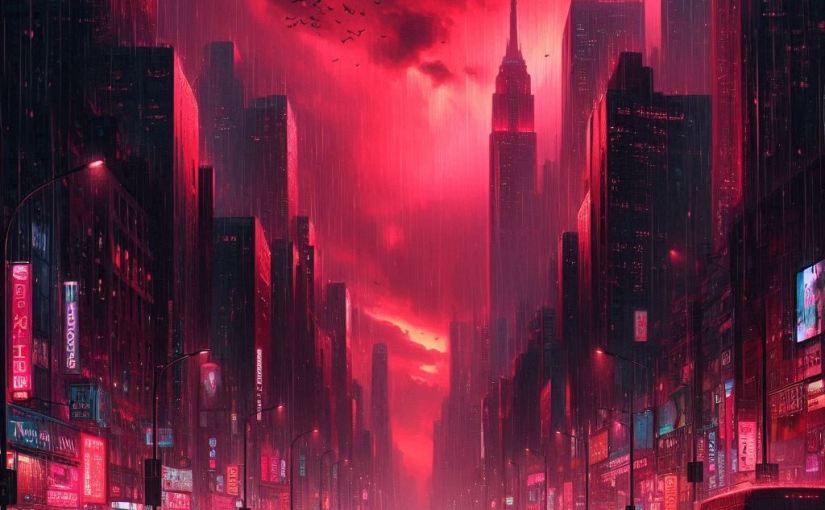
Gazing at this crimson sky,
— it seems a mirror —
Of the blood-soaked earth,
Spoils of that war…
And the rain is precipitated
It can hardly wait to fall…
Washing the soil,
like cleaning a sidewalk,
that dirties as it dries.
Adapted from:
Olhando, este céu vermelho
— parece espelho —
Do sangue desta terra,
Espólio dessa guerra…
E a chuva precipita-se,
Mal espera pra cair…
E lava o solo,
como quem lava a calçada,
que suja-se ao passo que seca.
Poetry looks beautiful in books, but how does it fare on websites?
To date, we haven’t found a sensible way to format poetry online. What do we do when our verses are so long that they spill over to the next line? How do we visually cue the reader that the continuation is part of the same verse and not a new one? We solve this by indenting the overflow to the right. That’s what’s called hanging indent. Read https://epubsecrets.com/well-hung-poetry-ebooks-and-indents-part-one.php for additional context.
General guidelines suggest using the <p>
tag for paragraphs and the <br> tag to break the paragraph into verses when formatting poetry with CSS. However, here I use the <span> tag for verse separation instead of the <br> as it provides more freedom to style the verses.
For the desired effect, I use three CSS properties: ‘padding-left’ and ‘text-indent’ for the <p> tag and ‘margin-left’ for the <span> tag. Here, I apply 3em of space.
The ‘padding-left’ property sets the space between the content and the left border, while the ‘text-indent’ specifies the indentation of the first line in a text-block. I then use the ‘margin-left’ to indent the other lines of the text-block.
To illustrate how the css code would look:
<h2>So you sit to write</h2>
<p style=”padding-left: 3em; text-indent: -3em;”>You are well versed on how this single verse works
<span style=”margin-left: -3em;”>An added verse and that’s a whole nother story</span>
<span style=”margin-left: -3em;”>These ‘oneliners’ need to talk to each other</span>
<span style=”margin-left: -3em;”>At times they just need to listen to themselves</span></p>
This produces the following output:
You are well versed on how this single verse works
An added verse and that’s a whole nother story
These ‘oneliners’ need to talk to each other
At times they just need to listen to themselves
I recommend reading this in a browser (that’s where you should read this blog) to see how it works, and avoid using the Jetpack app reader. Otherwise, my verses might lose impact because I vary the way I structure them, and you might miss the clear separation scheme I intended for a particular poem. Sometimes, they might even look messy due to the app’s built-in styling choices.
If you’re on a mobile device, I suggest you try portrait and landscape page orientation to see how it affects the reading experience. As long as you read in a browser, it should look fine both ways.
I’d love to hear your thoughts on how poetry formatting works best for you online. Your feedback is invaluable in refining these approaches and making poetry more accessible and engaging in the digital realm.
Feel free to leave a comment and join the conversation!
I’ve updated the anthology to include this new poem.
There lived an okay poet, a man of his word.
No one lived happily ever after.
Before them, an okay life — stretched out.
Like poet, like audience.
The okay poet said, “it’s okay to be sad.”
I wouldn’t go that far as to go gentle into the night.
Far be it from me to run away from the set of conditions.
Yet I wouldn’t be caught between a rock and a hard place.
Isn’t it okay to be great?
The Words’ Word shapeshifts before these words.
Hey, wanna talk?
You’re not all about the prose, all smiles, I get it.
You may tell me your p – o – – e m s.
Let me fix you a coffee.
Hmm, I should’ve offered it sooner.
Like, this strophe’s opening verse
belongs in the second line, first strophe, right?
You do this poetry thing so well,
I didn’t even know where to start.
Coffee is your cup of tea; mine too.
Remember that poem you wrote about it?
By the way, you’ve written a lot.
Tell me your p – o – – e m s.
State your dilemmas.
I don’t wanna force a friendship,
I just wanna reach you out.
This may be the only way.
Those latest verses… Are you in pain?
Was that your lyrical or physical self?
Were they a cry for help?
Talking’s tough, I get it.
You can write to me instead.
Sure, I’ll pay more attention to your next verses.
You’ve decided to talk. That’s great.
Could we talk in private?
Since I have some time now, I’ve put together this anthology for you all. If you think my effort is worth it and the quality is good, feel free to buy me a coffee, there’s a button at the end too. Feel free to share this post and comment too.
I’ve also added a few extra poems that you might not have seen before.
I’m testing an intricate idea here. This post is a single post with a collection of poems separated by pages (you might see page breaks depending on where you are reading this), with chapters and titles organized by the appropriate headings (no hyperlinks). Call it my postfolio; it’s a post analogous to a book.
Welcome to a journey through language, writing, and the metatextual world of poetry. We’ll explore how language can be both a creative tool and a barrier. From the playful frustration of crumpled drafts to the powerful imagery of ink and blood, these verses challenge traditional forms, blending free verse with deliberate constraints.
The author
What positive emotion do you feel most often?
Inspiration.
How powerful is an emotion when you want others to feel it as deeply as you do?
Write to inspire… to write to inspire.