Negatives

Gaslit mind, mine is blind.
Sunlit eyelids, covered eyes.
Afterimage, booby prize.

It couldn’t be any different,
Out of sight, out of mind.
A snap of a finger (hypnotic drive).
Brainstorming impulse; cloudy eyes.

While karma’s a bitch,
trauma is its son.
Creativity is a burden;
It might as well die.

All the photos I refused to take,
All the group photos I was left out of,
Aren’t making it any better;
The negatives neither.

Anthology Reveries that I call Poetry | by T!el Fajardo

Buy me a Coffee~


Since I have some time now, I’ve put together this anthology for you all. If you think my effort is worth it and the quality is good, feel free to buy me a coffee,  there’s a button at the end too. Feel free to share this post and comment too.

I’ve also added a few extra poems that you might not have seen before.

How This Works

I’m testing an intricate idea here. This post is a single post with a collection of poems separated by pages (you might see page breaks depending on where you are reading this), with chapters and titles organized by the appropriate headings (no hyperlinks). Call it my postfolio; it’s a post analogous to a book.


Introduction

Welcome to a journey through language, writing, and the metatextual world of poetry. We’ll explore how language can be both a creative tool and a barrier. From the playful frustration of crumpled drafts to the powerful imagery of ink and blood, these verses challenge traditional forms, blending free verse with deliberate constraints.

The author

The Power of Inspiration: Acting as a Catalyst and a Conduit through Writing

What positive emotion do you feel most often?

Inspiration.

How powerful is an emotion when you want others to feel it as deeply as you do?


Write to inspire… to write to inspire.

Exploring the Challenges of a Nonet to Summarize the Challenges of Poetry in General

As poets or creative writers in general, we often embrace constrained writing, with its self-imposed limits. While writing freedom is cherished (even considered paramount), constraints can spark creativity, whereas absolute freedom, without a critical intuition for what makes good writing—especially in poetry—can have the opposite effect.

To explore constrained writing, poets have developed various forms, like the nonet. Some forms are more justified than others (well-accepted by poets and readers of poetry), as certain structures may become too rigid, potentially suffocating emotion and meaning.

While constrained poetry often focuses on syllable count, word count can be an equally intriguing challenge. My poem ‘Ink Over Blood,’ the first I wrote seriously in English, plays with this concept. Here I transcribe it, but please follow the link and read it in its original post:

Ink Over Blood

Rain down the reign
Wash away royal blood
The old king’s dead
Long live, new king
Provided the kingdom remains

Gold rule, dark days,
Poet lies, folk sway.
Word wars, fake lore,
King dead, none lead.

See, these four-word verses
Like the four-letter words
Picture a wicked world;
Curse all the kings
For the poet’s takeover.
[The poet takes over.]

This poem remains a personal favorite of mine, as it represents a significant moment in my writing journey. But let’s return to the main point: demonstrating the challenges of constrained poetry, specifically the nonet—a form that, while deceptively simple, presents significant challenges.
This form highlights the tension between freedom and restraint, and I take avantage of the opportunity to raise a question about what truly makes good poetry. Is poetry, and creativity at large, ever truly free from constraints?

Hear me out, ‘mnot saying it out loud
I’d rather whisper it to you
It’s not a word for this crowd
Pack it up everyone
Go and have some fun
Oh, you’re still here
Expecting
Something
Big?

Some might see this arrangement as clever—I would not call it a solid poem—, but it’s important to acknowledge the difficulties presented by the form and this piece’s deficiencies. The nonet’s rigid structure often forces compromises, like breaking sentences unnaturally, especially if you’re unfamiliar with words (as concepts) that are succint and yet have multiple layers of meaning.

One thing I avoid is overly relying on enjambment and slicing up sentences just to fit a form, especially if it dilutes the message or meaning. I’ve seen the extreme of taking a particular common saying or any line of thought not inventive enough, slicing it into three or four verses and calling it a poem. More power to anyone who wants to venture into poetry, and make it more accessible as everyone starts somewhere—but let’s not level down what is [good] poetry.

The final four lines—’Oh, you’re still here / Expecting / Something / Big?’—only work in some way because the earlier lines establish a complete thought in a single verse, but it’s only natural to accomplish that more easily with more syllables or words (becoming significantly difficult as we limit the syllable count). Capitalizing the first letter of each verse also helps them stand alone, masking the form’s constraints and the challenges they present.

While poetry can at times thrive on the principle of ‘less is more,’ it’s crucial to find a balance. Overly constrained forms can limit expression just as much as excessive freedom can dilute meaning. The challenge is to navigate these extremes to create poetry that resonates.

cup of coffee gif

Let me hear your thoughts.

Would you buy me a coffee?

Enjoying what you’ve read so far? :) I’ve set up a Buy Me a Coffee campaign on Ko-fi so you can support my work  if you’d like.

While we can’t meet in person in a cozy café to chat about poetry, prose, and other literary delights, this is my virtual way of extending this sentiment. Online can be less akward, you might say.

You can always share your love and feedback in the comments, or e-mail me at infornografo@gmail.com.

Your support helps me continue sharing my passion, powered by coffee~, with you.

Here’s a button for styling purposes. You’ll be redirected to ko-fi for a one-time coffee.

Buy me a Coffee~


sending virtual hug gif

Is Aphantasia Actually Bliss?

I’m an aphantasic, and this means I can’t visualize. I can remember, recall, and recollect verbal descriptions of people and things, but not the associated mental images. Either there is no image or the monitor is malfunctioning.

However, I’m much better with “sound”, having been considerably trained in music. I have an inner monologue, but no actual auditory internal sound.

When I read a book, I might take longer breaks between chapters than the average reader (presumably not aphantasic, as aphantasia affects no more than there or four percent of people) just to process all the information . I’m good with descriptive language, as long as I don’t stress myself trying to picture the scenery. But I prefer it concise; too much information thrown together is tiresome, and I suspect it is for non-aphantasics as well.

Questions like “Where do you see yourself in X years?” exhaust me. While I can’t speak for others, I can speak for myself: you can’t expect a chessmaster’s mind from someone too absorbed in the present moment. Aphantasic (or not?).

Although I am not a master of mindfulness, I’ve trained considerably my focus (on the present moment, by definition). This training, along with breathing exercises, has helped me manage my anxiety and become more energy efficient.

Speaking of energy efficiency, I wonder if all the imagery in hyperphantasics’ minds don’t consume a lot of energy, while aphantasic brains spend much less. I also wonder if aphantasics aren’t naturally skilled at abstract/conceptual thinking, as it’s their primary tool.

ADVANTAGES
While some might view aphantasia as a limitation, there are possible advantages to consider. For instance, being unable to visualize may mean fewer distractions. It’s easy to focus on the task at hand without mental images cluttering my thoughts, but I don’t know the other way (if only I could toggle a switch on and off to test that). If there is a connection, it’s particularly beneficial in fields that require intense concentration and problem-solving skills.

Additionally, my reliance on verbal and auditory information has sharpened my ability to understand and remember complex concepts through words and sounds alone. This skill has proven invaluable in my musical training, where I can concentrate deeply on auditory details that others might overlook.

DISAVANTAGES
Of course, living with aphantasia isn’t without its challenges. One significant difficulty is the inability to use visual aids for memory and learning. While others might use mental images to remember faces, places, or events, I have to rely on other strategies.

Moreover, the common societal emphasis on visualization, seen in phrases like “picture your success” or “visualize your goals,” can be frustrating. These concepts are often alien to me, and adapting them to my experience requires creative thinking and adaptation.

EMBRACING APHANTASIA
Despite these challenges, I have come to embrace my aphantasia. It has pushed me to develop unique coping strategies and has fostered a deep appreciation for other senses, particularly sound. My ability to live in the present moment, without the distraction of mental images, has also enhanced my mindfulness practice, helping me manage stress and anxiety effectively. But then again, I don’t know the other way (for a true comparison). It would be no more than anedoctal evidence, anyways.

In conclusion, while aphantasia presents certain challenges, it can also offer unique advantages. By focusing on these strengths and developing strategies to overcome the difficulties, I have found a way to thrive. So, is aphantasia actually bliss? For me, it has become a unique part of my identity.


You don’t have to see it, or picture it to imagine it, despite the “image” metaphor being used in the word (concept) imagine. But it’s good that you can do it. While I can’t.


Crumpled Language

̶I̶’̶v̶e̶ ̶n̶e̶v̶e̶r̶ ̶m̶e̶a̶n̶t̶ ̶t̶o̶ ̶w̶r̶i̶t̶e̶ ̶t̶h̶i̶s̶
This, on the other hand…

I miss much more than I hit
Crumpled papers into a wastebasket

Five hits in a row
Is’t by chance?
Perhaps a blossom of skill?

Paper toss is quite a sport
You even start mistyping on purpose
For the sake of the game

T!el Fajardo
Jul. 04, 2024

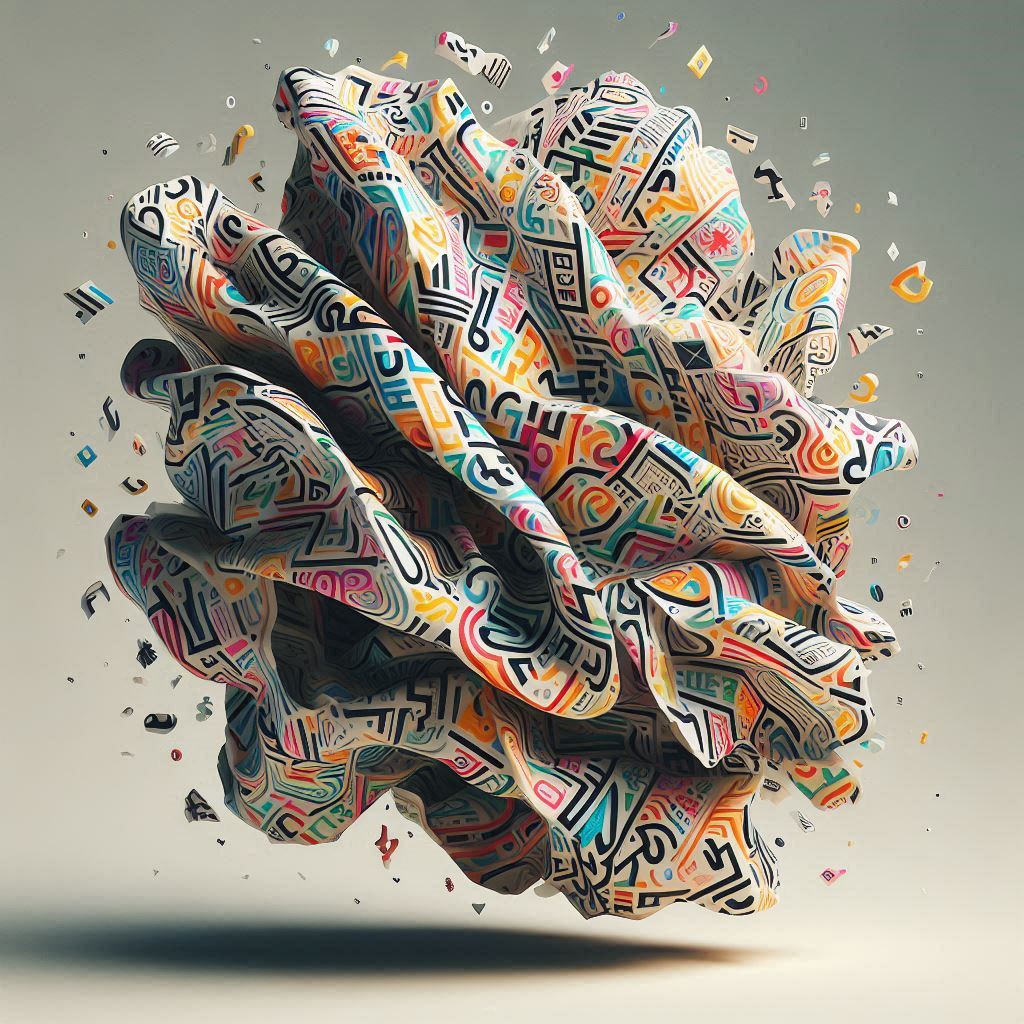
crumpled language AI art