Writing poetry is like bowling. One verse is a strike! some are gutter balls. Consistency, the key. Take it in stride. Play for the sake of playing. On words? Always worth the fun. Your words can be built differently. Don’t be fooled by the urge to rhyme. See? It just landed.
Have you ever dreamed of the biggest dream you have dreamed about? I have never. Let alone dreamed of it becoming true.
I even questioned the extent of my ambition. Once and nevermore. “Why would I not dream of it even once?”
Have you ever considered not daydreaming too much about it? I have. It is not like I would forget what my biggest dream is. Perhaps I would start dreaming of it…
It comes the night. Silently waving goodbye to the day.
Good night. I wish you a lucid dream (I have never had one).
But I sing to you this lullaby. A daily reminder for the big dream eventual fulfilment.
You know better than to know better
lies: you’re worse at what you do best
Or are you better at what you do worst?
Well, anyway, that doesn’t matter
Don’t you play the fool for me
I know better than to know paradoxes
Or thinking outside of those boxes
I know better than to write all this lingo
I’d be better off to live real life
A subconcious slight paraphrase of ‘Small But Refined’ by Emily Romano
So, Shadow Poetry website provides two examples of the musette form, with different rhyme schemes for the middle section (second stanza): cdd and cdc; as far as I know cdc is the preferred form, mantaining “symmetry” (aba cdc efe).
Syllabication considered, do you pronounce inspire and expire with two or three syllables? As it would rhyme with hire and/or higher, are these homophones or is hire monossylabic?
Anyways, for the musette, is the syllable count considered up until the last stressed syllable of the verse or the actual last syllable? I’m assuming the latter, but I’m more familiar with the former.
A shout-out to Ryan Stone, who introduced me to the musette form through his beautiful poem:
Welcome to their life.
It might be an open book
— though, unlike a certain kind,
left opened to the same page as ever
because one is obsessed
with a narrow frame of it.
Are we on the same page?
Life together is a mutual reading. Will you read their last page as they read yours?
Will you commit? Will you compromise?
Welcome to their life. It’s free to enter but pricey to leave.
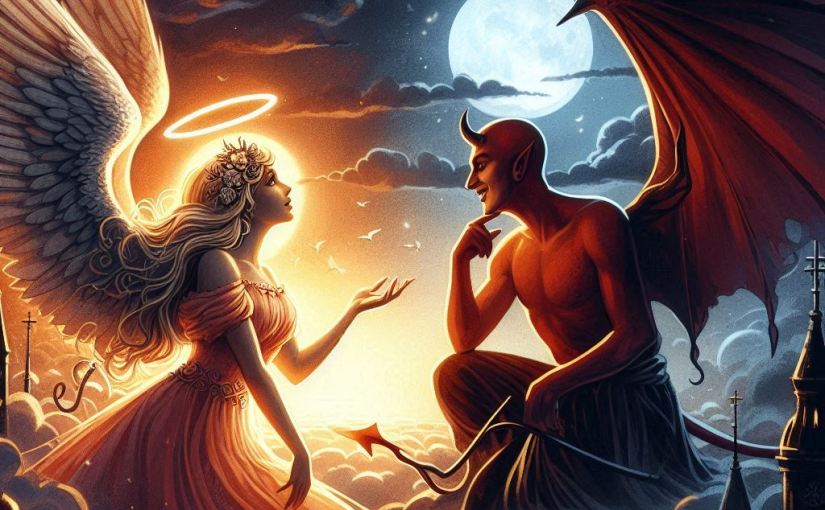
— I’m the inevitable devil,
who knows your damn blues.
— I am the light,
the true morning star.
— That title sure suits you.
I prefer being ‘the midnight’.
Now you should be sleeping, oldie,
Lemme burn more oil for now.
— Oh, well, that’s fun,
but take my advice.
Delay casting shadows,
day’s about to shine.
When you return tonight,
be sure to bring damn wine.
I can hear a song out of it, I have a melody in mind. What do you think? Would you be interested in seeing where it leads/ how it gets? If you can think of something as well, though, let me know. We can colaborate in some way.
A poem on the go… Does it know where it is supposed to go? … It must do so for it is no go relying on my guidance. … Just go for it, poem, whatever you are up to.
I Hope the pen doesn’t run out of ink soon. Run, pen, run. I hope I don’t run out of gas. Run, poet, run.
You know, this pen lives a life of its own. Yet it bleeds to death if need be. In turn, the paper accept what is. That is ever requited love, that love of craft. The love of self (the poet), the muse might very well reject.